
Swivel Chair Syndrome
Swivel Chair Syndrome
Are your people your system integration layer?
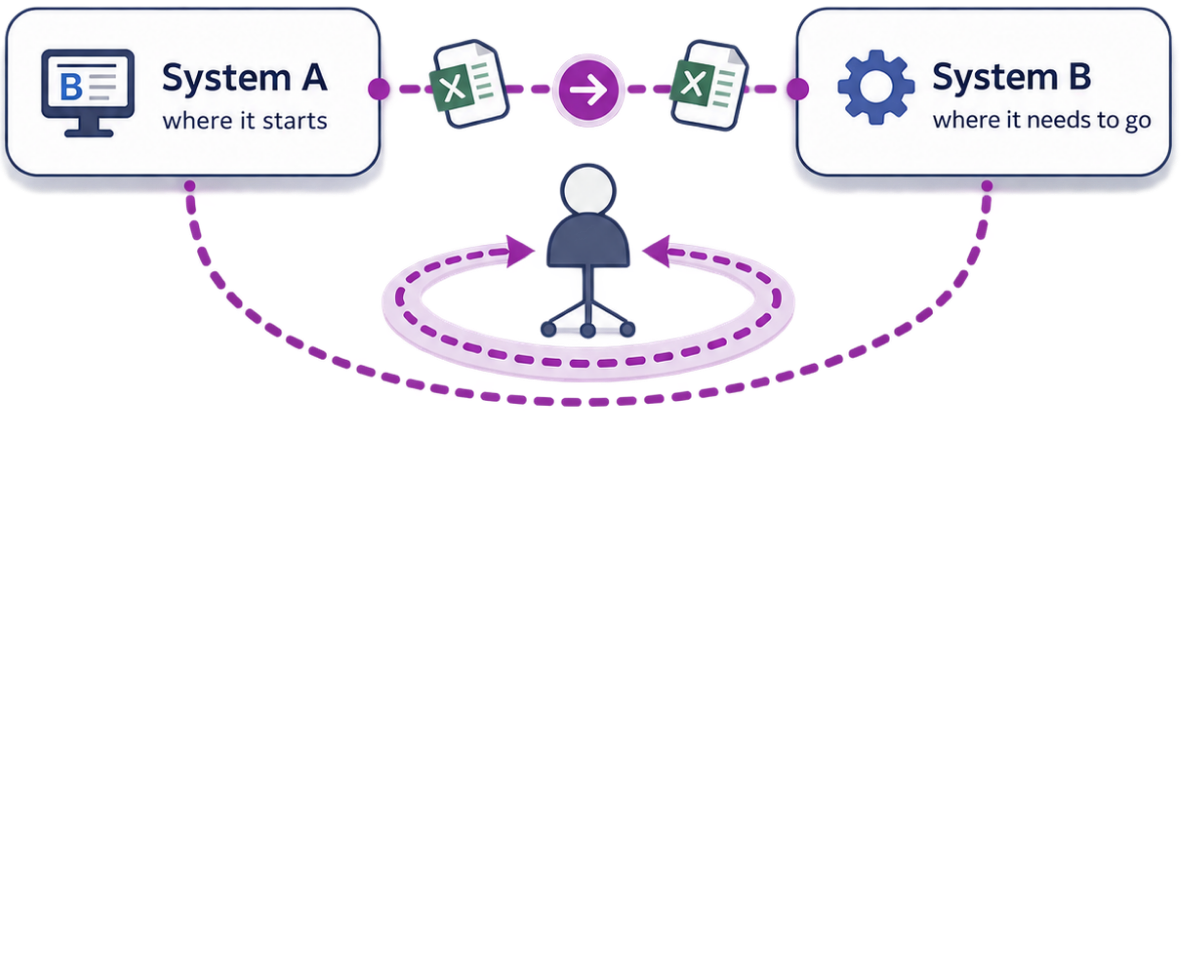
When two systems can’t talk to each other, someone has to be the go-between. They read a value off one screen and type it into the next or export a file from here and upload it over there, all day. It’s the kind of dull, repetitive handover software is supposed to do by itself. Instead, you’ve hired a person and turned them into the connection between your systems.
None of this scales. It’s slow, it breaks as you grow, and every handover is a chance for an error no one catches. It also holds back any real transformation, which only happens when your data is one connected picture, not a jigsaw someone reassembles by hand every day.

The daily swivel and
what it’s costing you
The double entry
The same data gets typed in twice, by two different people, into two different systems.
So the work gets paid for twice
You pay for it once in each system, and every re-key is a chance for an error nobody catches until much later.
The three-place update
When one thing changes, you’ve got to update it by hand in every system that holds it.
So it breaks the day someone’s off
The person who knows the routine is a single point of failure, and when they’re away the swivel doesn’t happen.
The reconciliation hunt
Two systems disagree, and someone loses half a day working out which one to believe.
So you can’t trust your own numbers
Nothing reconciles on its own, and there’s no trail to trace when a figure’s wrong, so every report starts with a debate about whose data is right.
The swivel isn’t the job,
it’s the gap
You didn’t hire your people to re-type data from one screen into another. The swivel exists because two systems that should share information don’t, so a person has to fill the gap by hand.
Find the swivel and you’ve found exactly where an integration is missing.
None of this lands as a line on a budget, because the swivel hides inside everyone’s normal day. The cost is real all the same. It’s there in the wasted hours, the errors caught too late and the growth that always seems to need more people, not better systems.
We start with the problem,
not the product
Most businesses never fix the swivel. It works well enough and everyone is used to it, so no one has stopped to ask the question underneath it. Which system should actually own this data?
When the same information lives in two systems, one of them has to be the master, the version everything else trusts. Often it is a system you already have, though occasionally neither is right and you need a new master that owns the data and feeds it to the rest. That is the decision the swivel has been letting you avoid.
So that is where we start, not with a tool. Once we know where the truth should live, the fix follows, whether a single automated step, a proper integration or bringing the work into one place. Map the flow once and it stops being something a person has to hold together by hand.
Where this might lead
Once we know what
the swivel is for
The right fix depends on the flow. It might be a single automated step or joining two systems together for good.
Microsoft Fabric
DATA PLATFORM
One connected source your systems can share, so nothing needs re-keying between them by hand.
Explore →Power BI
ANALYTICS
See the joined-up picture once your data flows between systems on its own.
Explore →Dynamics 365
CRM
Bring the work into one system, configured to fit your business, so there’s nothing left to swivel between.
Explore →Power Platform
APPS & AUTOMATION
Power Apps, Power Automate and Power Pages to automate the copy-and-paste between systems away.
Explore →Custom Applications
BESPOKE DEVELOPMENT
One custom-built place to do the whole job, so the swivel never has to happen.
Explore →What good looks like
The swivel is usually part
of a bigger picture
A swivel is rarely the only sign your systems aren’t joined up. It usually travels with a related pain, and removing it is often what clears the way for everything else.
The pains that travel with it
Platform
Pain
The swivel often exists because a platform won’t connect or no longer fits how you work.
Is your system holding you back? →PainExcel
Hell
The data being shuffled between systems usually ends up in spreadsheets too, which quietly become what your business runs on.
How much runs on a spreadsheet? →What removing it unlocks
Autonomous
Operations
The manual shuffle you do by hand is exactly the work that can run itself.
Let the routine run itself →GainConversational
Intelligence
Once systems share data cleanly, you can ask joined-up questions of all of it.
Ask your data anything →GainBusiness
Foresight
Consistent, connected data is what a reliable forecast is built on.
See what’s coming →We’ve done this before,
see what our customers think



Worried about the investment?
We don’t chase the biggest project, we scope the smallest one that makes the biggest difference. Discovery comes first, then a minimum viable product aimed at the highest-impact outcome, so you see the value clearly before committing to anything more.
Tell us about your swivel
Explain the systems your people are moving data between by hand, and we’ll work with you to understand whether connecting them is a quick automation or a bigger join-up. No pitch, no obligation.
Book a Call
Or call 03333 209 969 · enquiries@circyl.co.uk